
What to Write in a Language Journal When You Barely Have the Words
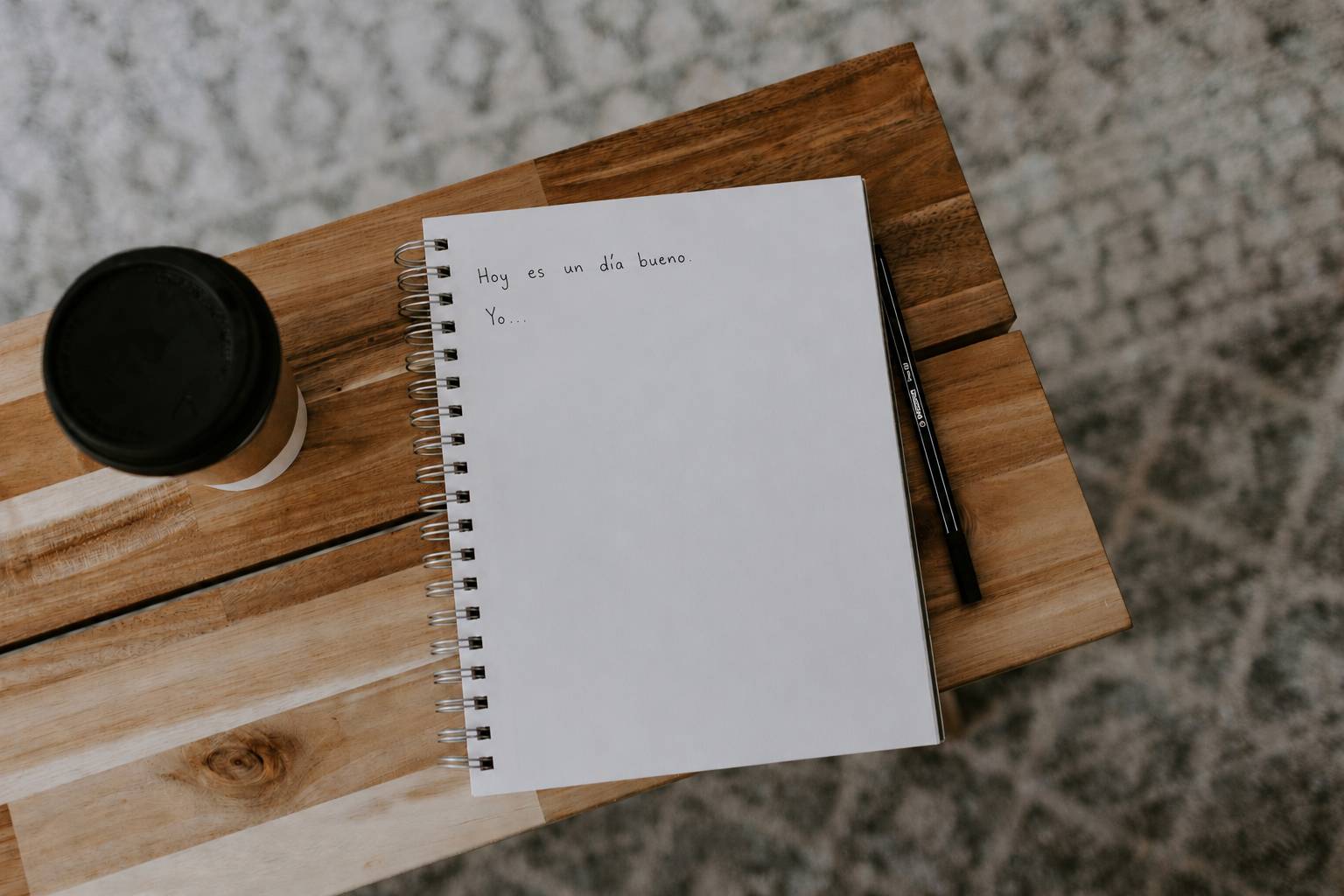
One of the first problems with language journaling is a stupidly practical one: you open the notebook, you have a whole life happening around you, and suddenly all you can produce is something like: I went to the supermarket. It was good. I bought bread.
Which is not exactly the Portuguese novel I had hoped to write when I moved to Lisbon.
At first, I found that gap a little humiliating. In English, I have opinions. I can complain about a bad coffee with unnecessary precision. I can tell a story, make a joke, go off on a tangent. In Portuguese, especially early on, I could barely report that I had left the house.
But that is not a sign that language journaling is failing. It is the point where it starts becoming useful.
When you barely have the words, do not try to write a beautiful diary entry. Write one small, true thing from your actual day. Then let the missing words show you what to learn next.
That is how a language journal stops being a blank page and becomes practice you can actually use.
What should you write in a language journal as a beginner?
The best thing to write is usually not a clever prompt. It is a moment you already lived through and would have liked to handle better in the language.
If you have just moved somewhere new, your day is full of these little moments. You had to explain something at the pharmacy. You got an email from your landlord that you understood mostly, which is its own particular flavour of stress. You met a neighbour in the hallway and managed the greeting but lost the plot immediately after that. You saw a sign you wanted to understand. You had a small win at the bakery and have been quietly replaying it ever since.
That is material.
You do not need to invent a fictional trip to the train station so you can practise the word for platform. Your real life is already giving you better assignments. If you are trying to build a life in a new country, the useful language is often hiding in the boring little things.
For this kind of journaling, a beginner does not mean someone starting from absolute zero. If you know a few basics but freeze when you need to use them, you have enough to start. You are not writing to prove that you are fluent. You are writing to find the edge of what you can currently say.
Start with one small scene, not your whole day
The easiest entry is one scene. Not a summary of everything that happened since breakfast. Just one moment that had some texture.
Maybe you tried to return something at a shop and gave up halfway through explaining why. Maybe your colleague said something funny in French and everyone laughed a little too quickly for you to catch it. Maybe you sat in a waiting room in Spain, listening to names being called, and realised you could understand more than you thought.
Write the scene in three parts:
What happened. Keep this plain. Who was there? Where were you? What did they say or do?
What you felt or thought. This can be very simple too. You were embarrassed. Relieved. Annoyed. Proud. Confused, which is a durable classic.
The sentence you wish you had been able to say. This is often the good bit. It might be a question you needed, a softer way to explain yourself, or just the joke that arrived in your brain ten minutes too late. That third part does more work than it looks like it does, because the answer you could not produce in the moment is usually the most useful thing you will write all week.
You may only manage five or six sentences. Fine. A short entry about a real moment has more life in it than a full page of polite nonsense about your favourite colour.
Write what you know first, then notice the gap
There is a temptation, especially when you are anxious about mistakes, to stop every few words and look everything up. Soon the entry has become a browser tab collection and you are somehow reading about the history of a Portuguese verb when you were trying to describe buying toothpaste.
I would write the version you can manage first.
Let it be clumsy. Let it have the same safe verbs you always use. Let it be missing the exact word for the thing that happened. The first version is useful because it shows you what is already in your head, and where you keep reaching for the same old escape hatch.
Then review it. Look up the one or two words that really mattered. Get feedback on the whole entry if you can. Compare the corrected version with what you wrote. The goal is not to turn every sentence into something a nineteenth-century novelist would admire. The goal is to notice one phrasing you can borrow next time.
That was the part that changed the practice for me. In my early Portuguese entries, I could see exactly which ideas I kept abandoning halfway through. Once I had a corrected version in front of me, the language was no longer some vague mountain I was meant to climb. It was a sentence. Then another sentence.
If you want the longer version of how that habit started for me, I wrote about it in How Journaling in Portuguese Changed My Language Learning.
What do you write when your life feels too repetitive?
This is the objection that comes up after a few days: yes, but what if every entry is just work, dinner, scrolling on my phone, bed?
First, that is most people's life. Congratulations, you are doing extremely well at being a person.
Second, repetition is not the enemy here. It is where your useful vocabulary starts to show itself. If you write about your commute three times in a week, you will keep meeting the same verbs, places, complaints, and small details. They begin to belong to you.
Still, there are ways to make an ordinary day more interesting without turning the journal into homework. Try one of these:
Describe the version of the moment you did not say aloud. You made it through a conversation, but you had a better answer in your native language. Write that answer now.
Zoom in on one detail. The smell of the bakery, the strange waiting-room music, the dog that barked at you with much more confidence than you currently possess in German.
Write the before and after. Before the phone call, you were nervous. Afterwards, you realised you had understood more than you expected. That is already an entry.
Write a tiny complaint. Not a furious manifesto. Just the real irritation of trying to get an internet appointment in a language where you still sound like you have misplaced your adult brain.
The point is to write about things that are close enough to you that you care about finding the words. That personal pressure is much more useful than a random prompt asking you to describe a zoo you have never visited.
How long should a language journal entry be?
Shorter than you think.
Five honest sentences are enough. Three are enough on a tired day. One sentence can even be enough if it is a sentence you genuinely needed.
The habit becomes easier when the entry has a small shape. You are not promising yourself that you will become the kind of person who writes three luminous pages every morning while birds land on the windowsill and the coffee is somehow always perfect. You are sitting down for ten minutes and catching one piece of your life in the language you are learning.
Some days it will turn into more. Some days you will write, I was tired today and I did not understand the man on the phone, and that is all. Both count.
Let the correction decide tomorrow's entry
The most useful thing about writing a real entry is that the feedback is immediately personal.
Maybe you notice that you avoid the past tense every time. Maybe your sentences are perfectly understandable but too literal. Maybe you finally learn the phrase you needed at the doctor's office last Tuesday. That gives you somewhere to go tomorrow.
You do not need to study every correction like you are preparing for a diplomatic exam. Pick one thing. Reuse it in the next entry. Write one new sentence with it. Say it out loud while making coffee if you want to feel mildly ridiculous in the privacy of your own kitchen. Do this for a few weeks and the same handful of mistakes tend to surface, which is annoying in the moment but is actually the fastest way to know exactly what to fix next.
That is enough practice to make a small difference over time.
Where Bonjournal fits
Bonjournal is built for this exact loop: write about your real life, get the entry corrected, understand the changes, and keep a history of what you are learning. It is not a course for someone who has never encountered the language before. It is for the moment after the apps and lessons, when you know some of it but want to use it for something that belongs to you. If you have more questions about how that works, the FAQ covers the basics.
If you are staring at a blank page today, do not wait for a better prompt. Write about the last small moment that made you wish you had more words.
That is probably where you should begin.
Try Bonjournal free → No card required. Your first entry can be one sentence.