
How Journaling in Portuguese Changed My Language Learning (And Why I Built Bonjournal)

(and the kind of spot I'd send photos of to my mom)
My language learning journeys usually start quite romantic: I fall in love with a sound. Then with the image of me making that sound (and how cool I look doing it). Then with how pretty the world looks when that language is floating around me, like pink clouds, and I'm a bird flying around tweeting lovely Spanish or Portuguese tunes.
That dream usually came sizzling down as soon as I spent a few weeks on apps like Duolingo or Babbel and noticed that I wasn't getting much closer to feeling like a bird flying through pink clouds, diving into pastéis de nata and plates filled with tapas.
I think I'm not the only one who got disillusioned by the easy way into languages that these apps provide. Sure, they offer an entrance — maybe even a pretty good one. But an entrance is also just that: a limited way in.
When I moved to Portugal a few years ago, it dawned on me rather quickly that I could not get by with reaching the intermediate level on Babbel. So I did what most people would do: I got a teacher. And that helped me move up quickly. Then reality kicked in — teachers are expensive, and so was my adult "look mom, I live in Portugal right now and enjoy the beach every single day" lifestyle. My money and my time were precious. I needed a steady and convenient way to practice my Portuguese.
So I got a Brazilian girlfriend.
Sorry, that's a joke. Well, not really — I am married to a lovely Brazilian woman (olá, meu amor!) — but as much as being in a relationship is a good way to immerse yourself in a language, it's also, in my experience, a good way to risk your relationship due to poor communication. (I've written more about what actually changes when you marry into another language, if that's your situation too, and about learning Portuguese in Lisbon when the Portuguese at home is Brazilian.) So, circling back: I wanted to find a convenient practice.
I first heard the term "language journaling" on Portuguese With Leo, a podcast that carried me through a lot of my early Portuguese. Leo mentioned it as a technique in passing, and something about it clicked. I started looking into it.
What Is Language Journaling, Exactly?
Language journaling is the practice of writing journal entries in the language you're learning. About your morning, something on your mind, whatever comes up — like regular journaling, just in a foreign language.
It sounds almost too simple to work. But that's part of the point. The power of language journaling comes from the fact that you're expressing things that matter to you, whether they're simple or not. By reaching for the words to describe your life, your feelings, your day, an emotional connection is created to the language and the practice. This personal context, I believe, makes for a very engaging and motivating way to learn. (If you're curious about the method, I've written up some common questions about language journaling.)
So I bought a cheap notebook from the papelaria down the street and started writing every morning. In Portuguese, with my meia de leite, as fitted my "look mom, I live in Portugal now and next to the beach I drink cheap coffees in the sun every morning" lifestyle.
The Messy Notebook Phase
The first phase was exciting and messy. At times, I was barely able to string a sentence together, so I'd grab my phone to look up some words, get distracted, come back, and do the same thing again. But I quickly got better. The vocabulary and grammar stuck, because I actually felt personally close to what I was trying to express. Plus I put real effort into it.
It was a lengthy process, but I kept going, and every morning I looked forward to it. It became my daily, sacred little ritual.
This little language journaling ritual engaged me through personal context and motivation, rather than educational structure or force. This was the first language learning practice that I found myself wanting to come back to, and keep challenging myself with. I finally found a practice I could actually enjoy and be consistent with.
Here's what I noticed after a few months of daily language journaling:
I stopped thinking in English first. When you journal every day in your target language, you start forming thoughts directly in that language. Not translating on the fly, but actually thinking in it. That's a massive shift — and it turns out there's a lot more to say about why that happens and how to get there.
My vocabulary became personal. Instead of memorizing generic word lists, I was learning the Portuguese words for things that mattered to me. My work, my neighborhood, my relationship, my frustrations. This vocabulary stuck because it was tied to my real experiences and emotions.
I discovered my weak spots. Journaling is brutally honest. You quickly notice which verb tenses you avoid, which sentence structures you fall back on, which words you keep looking up. That awareness alone is valuable, but it also made me crave feedback.
And that craving for feedback is where things got really interesting.

Adding AI: The ChatGPT Experiment
The problem with journaling on my own was that I had no idea how many mistakes I was making. A teacher would catch those mistakes — but I'd already established that teachers were too expensive for me. Besides, I now had to take a daily coffee cost with my little language journaling ritual into account.
So one morning, I typed my journal entry into ChatGPT and asked it to do three things:
- Give me a corrected version of what I wrote
- List every correction with a brief explanation of why
- Offer some coaching feedback on the actual content, like a supportive language teacher who also happened to care about what I was saying
The result kind of blew me away. In one response, I got grammar corrections I could learn from, vocabulary suggestions that felt natural rather than textbooky, and thoughtful reflections on what I'd written. It wasn't just language learning anymore, it was language learning and personal reflection wrapped into a single daily practice.
I started doing this every day. Write the entry, paste it into ChatGPT, get the feedback, learn from it. And I started improving noticeably faster than I had with any app or class.
Why This Combination Works So Well
I've thought a lot about why the combination of journaling and AI feedback is so effective, and I think it comes down to three things.
Relevance makes it stick. When you write about your actual life, the vocabulary and grammar you practice are immediately useful. You're not learning the Portuguese word for "train station" because a textbook told you to. You're learning it because you wrote about your commute. That relevance creates stronger memory connections.
The feedback loop accelerates learning. With a traditional journal, you write and move on, mistakes and all. With AI-corrected language journaling, every entry becomes a mini lesson. You see exactly where you went wrong, you understand why, and you naturally start avoiding the same mistakes next time. Over weeks and months, you can literally look back at your earlier entries and watch yourself improve. Plus, with this history log, you can simply use AI to spot your recurring patterns and potential growth areas.
Two habits reinforce each other. Journaling on its own is already one of the most established personal development practices out there. Language learning on its own requires daily consistency to make progress. Combining them means you journal because you want to reflect, and you write in your target language because you want to improve. Neither feels like a chore because both are meaningful on their own. It's a flywheel.
The Duct Tape Problem
But my daily process was turning out to be clunky. Every single day I'd write in my notebook, type it into ChatGPT, paste the prompt I'd refined over weeks, and wait for the response. Sure, the conversations were saved, but they were scattered across dozens of chat threads with no structure. Try finding that one correction about the subjunctive from three months ago. Hassle. There was no way to compare entries over time, no overview of recurring mistakes, no streak to keep me honest, no sense of progression.
I'd also refined my ChatGPT prompt over time — tweaking the instructions for better corrections, more natural explanations, more useful feedback. That prompt was doing real work. But the whole workflow was held together with duct tape and manual effort.
It was a very lengthy process, and I had beaches to go to and send photos of to my mom.
But I'm a web developer and I love finding problems to solve (Olá outra vez, meu amor!). At some point I looked at what I was doing every morning and thought: this should just be an app.
So I Built Bonjournal
Bonjournal is the app I wish I'd had from the start. The idea is straightforward: take the exact workflow that was working for me — write, correct, reflect, track — and remove all the friction.
You open the app, pick your target language, and write.
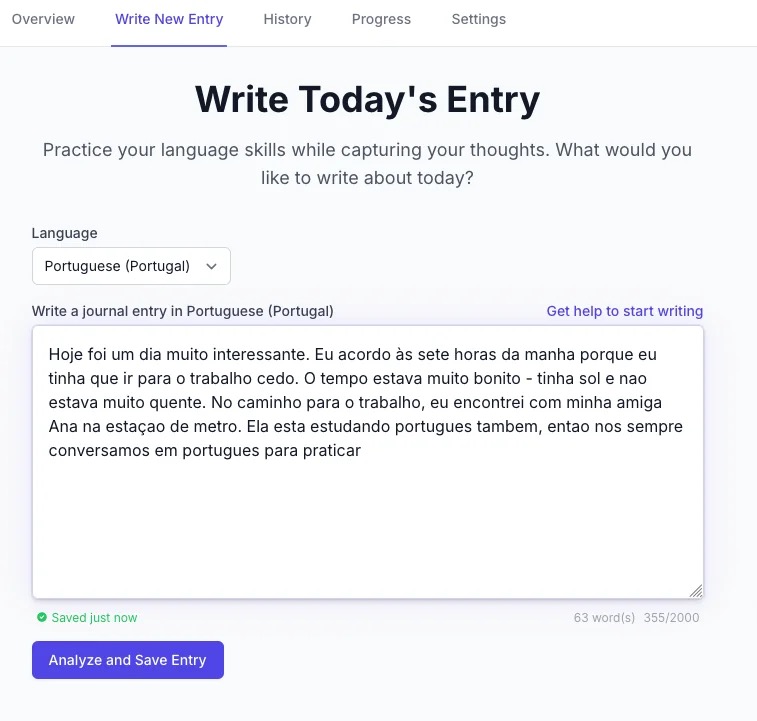
When you're done, you hit the submit button and get a full analysis: a corrected version of your entry, detailed explanations of every correction, progress scores across grammar, vocabulary, and verb usage, and personalized coaching feedback from an AI that actually engages with what you wrote.
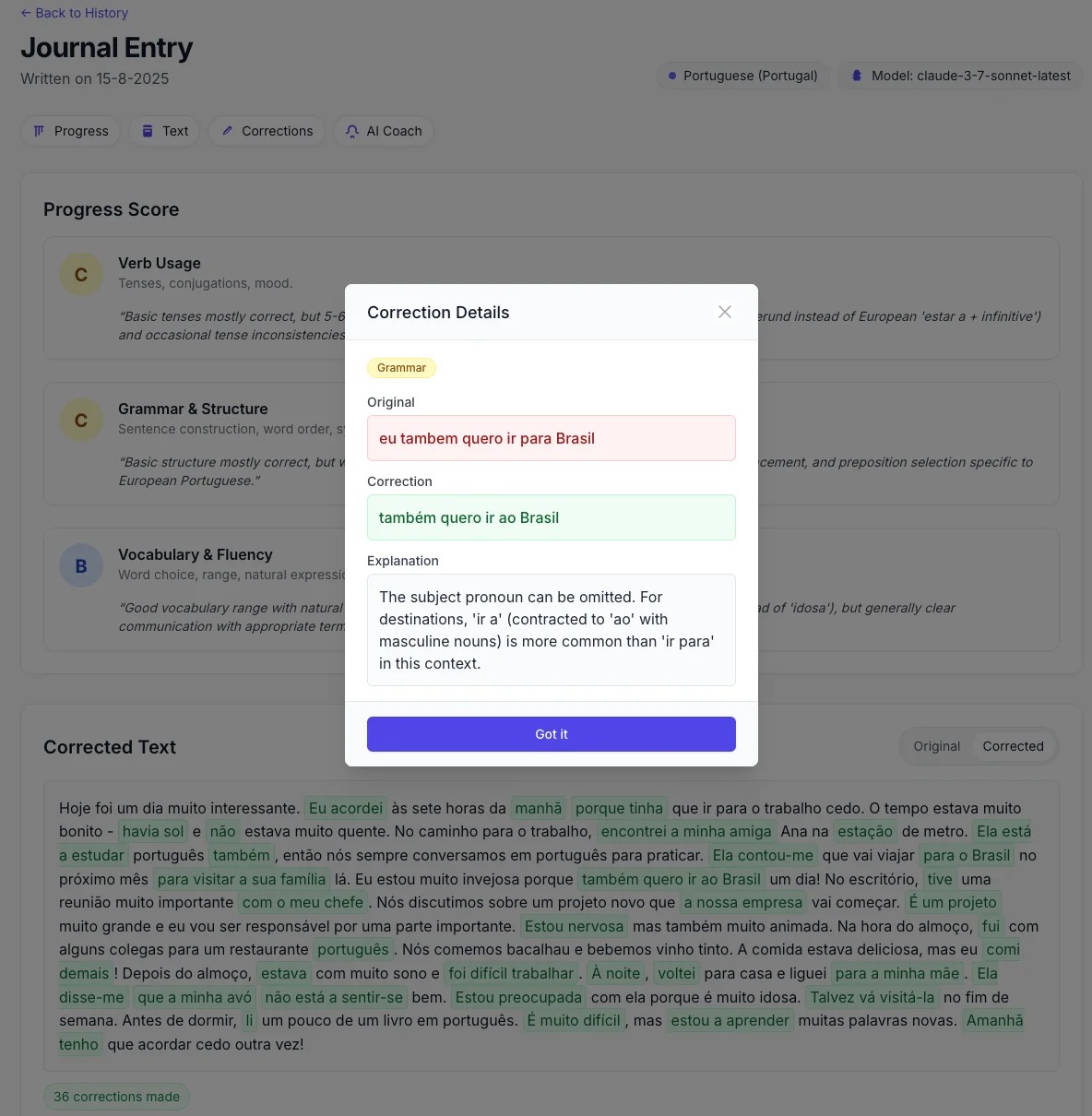
Everything is saved. You build a history. You can look back at entries from weeks or months ago and see how your language has evolved. There's a calendar view that shows your writing streak — which days you journaled, which days you didn't — because consistency is half the battle, and a little visual accountability goes a long way.
Bonjournal currently supports Portuguese, Spanish, French, German, Dutch, Italian, and English as target languages.
This Isn't for Everyone — And That's Fine
I want to be upfront about something: Bonjournal isn't trying to replace Duolingo or Babbel. It's not a gamified vocabulary trainer. It's not a conversation bot. It's not going to teach you the basics of a language from scratch.
It's a focused tool for a specific kind of language learner — someone who already has at least a basic foundation and wants to use their target language for something real. Someone who values the practice of writing, who wants to go deeper rather than wider, and who finds that personal expression is a more powerful motivator than points and leaderboards.
I know many people will look at it and decide it's not for them. That's completely by design. For those people who've felt that the common language apps teach you about a language instead of actually letting you use it or play with it — language journaling might be the missing piece.
Try It Yourself
Bonjournal is live at bonjournal.app. You can try the writing experience right on the landing page. No account needed. Write something in your target language and get a taste of what AI-powered language journaling feels like. Have questions first? Check the FAQ.
I'm not in Lisbon anymore (my mom does miss my beach calls), but I still do this on an almost daily basis. I hope it can click for you as it did for me!