
Why You Keep Making the Same Mistakes in Portuguese (And How to Actually Stop)

Imagine you're walking into your favourite coffee spot in Lisbon, Portugal. The one you've been going to three mornings a week since you moved over. And with a big smile, you order a café con leche, por favor.
The look on the barista's face takes your smile away. And you realize: that secondary school Spanish is still messing up your Portuguese. And your basic expat mistakes are wrecking your credibility with the local baristas. Because you saw that exact same look, for the exact same mistake, just the other day. Being slapped in the face by shame and a red blush, you don't even realize what the slip is exactly.
That's the part that gets you. Not the slip, but the slow recognition that you've been doing this for months, that the little expat bubble around you might be partly self-inflicted, and that you genuinely cannot point to what you keep getting wrong. You just know the feeling of having gotten it wrong, outra vez.
The mistake you don't know you're making is the one that sticks
You keep making the same mistakes in a foreign language because traditional feedback corrects individual errors but never surfaces the patterns underneath them.
Here's the trap most language learners are in, even the disciplined ones: we spend all our feedback on individual mistakes. A tutor catches a verb in the moment. An app marks an answer wrong. You nod, you move on, you feel briefly smarter. Three days later you make the same mistake in a slightly different sentence and nobody notices. Including you.
Single corrections fix the moment. They don't fix the pattern. And the pattern is what's actually shaping how you sound to a native speaker, because the mistakes you repeat have quietly become part of how you talk. They're not random slips. They're habits. And habits don't get unlearned one sentence at a time.
The problem isn't that you're not getting feedback. It's that the feedback you're getting has no memory of you.
Worth saying: this is a problem you only get to have once you're producing the language regularly. If you're still at the stage where you understand everything but freeze when it's your turn to speak, that comes first. Repeated mistakes are a sign you've started producing enough to have habits at all.
Why traditional language tools can't help you here
Apps, tutors, and grammar books can correct your mistakes in the moment, but none of them keep a record of your writing over time, which is what pattern detection requires.
This isn't a knock on those tools. They're built to do something else, and they mostly do it well. Apps drill vocabulary and grammar. Tutors correct you in conversation and explain the rule when you ask. Grammar books teach the rules in the abstract. All useful. None of them have a record of your writing, across your learning, over time. They can't tell you that you've been avoiding the subjunctive for two months, or that the preposition you're shaky on is the same one you've been shaky on since week one. That information lives in your output, not in their curriculum.
Which means the responsibility for spotting patterns falls to you. The person who, by definition, can't see them. (If you could spot your own blind spots, they wouldn't be blind spots.)
What it actually looks like when you can see your own patterns
The shift from single corrections to pattern-level feedback is the moment a language learner stops repeating themselves. Imagine opening your laptop one morning and reading something like this about your own writing:
Across your last eight entries, you've used estar where you needed ser six times, all of them when describing how someone feels about a situation rather than how they feel right now. Your vocabulary around work and routine is getting noticeably richer. Your vocabulary around emotion is staying narrow. When you write about your weekends, your sentences get longer and more confident. When you write about your job, they get shorter. Also, you keep making mistakes on gender-agreement with your adjectives.
That's a different beast from a red underline on a single word. It's the kind of thing a good tutor might tell you after reading a stack of your writing in one sitting, with the time and attention to actually look for patterns instead of just correcting line by line. (And without charging you for the hour.)
The reaction most people have when they read something like this about their own writing is a quiet huh. Then: I want to know more of that about myself. Because once you can see the pattern, you can actually do something about it. The mistake stops being a mystery you keep bumping into and becomes a specific thing you're working on.
How journaling makes this possible (and why apps can't)
Language journaling is the only common practice that generates the raw material pattern analysis needs: your own writing, accumulated over time, about things that actually matter to you.
Pattern analysis needs raw material, and the raw material has to be yours. Multiple-choice answers don't reveal anything about how you think in a language. Flashcards don't show which verbs you avoid, which topics make your sentences shrink, which emotions you can't quite name yet. Only your own writing does that.
This is why journaling, of all the slightly old-fashioned language practices, turns out to be the one that scales into something modern. Every entry you write is a small data point about how you currently think in your target language. Stack enough of them up and a real picture emerges. The habit produces the evidence, and the evidence is what lets the feedback get specific.
This connects to a long-standing finding in applied linguistics: focused feedback on a small number of recurring patterns (sometimes called focus on form) tends to outperform broad, comprehensive correction. The catch is that focused feedback requires somebody (or something) to actually read across your writing and figure out which two or three patterns matter most. That's where most language tools stop. And it's where Periodic Insights picks up. If you want the basics first, start with the FAQ.
Introducing Periodic Insights in Bonjournal
Bonjournal already gives you sentence-level corrections and a short coaching note after every entry. That handles the moment-to-moment side. Periodic Insights is the zoomed-out half.
Here's how it works: after your first three entries in a target language, and every five entries after that, Bonjournal queues a deeper review of your recent writing and runs it overnight. You wake up to a fresh one, ready for you to digest. The review reads across all your recent entries in that language and gives you three things:
- A quick gist: three observations you can scan in ten seconds
- A set of deeper observations split into strengths and pitfalls, each with a concrete try this challenge
- A reflective summary, written like a note from a coach
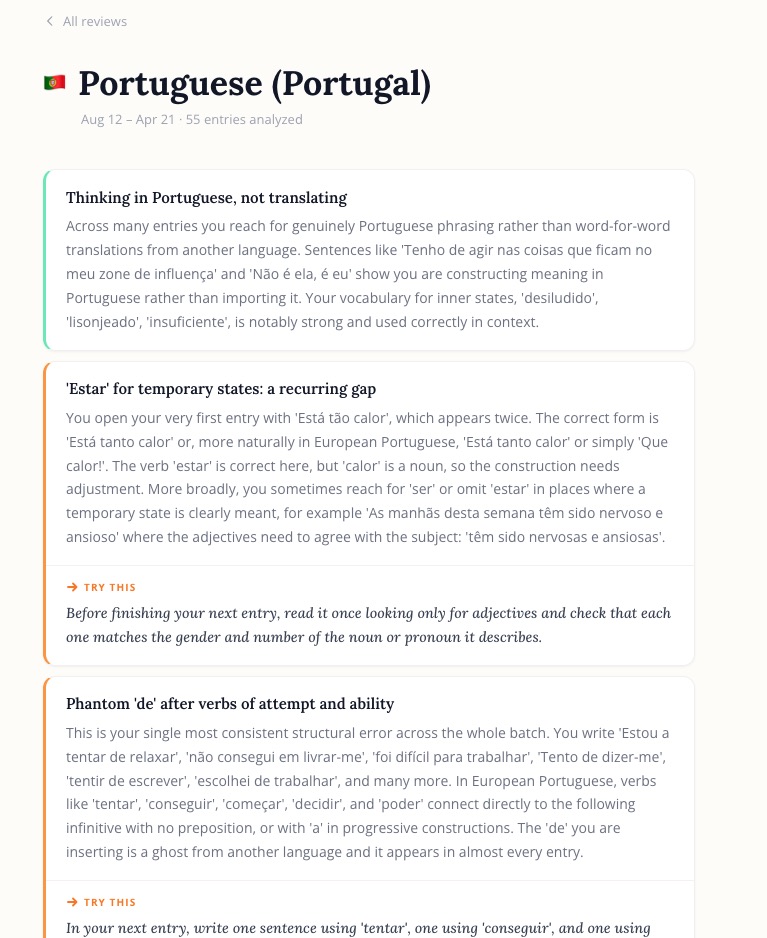
The patterns it surfaces are deliberately narrow. Usually two or three per review. This is on purpose, not a limitation. Second-language acquisition research consistently shows that focused feedback outperforms comprehensive feedback: a learner working on two specific things grows faster than one who's been handed a list of twenty. Most tools give you the list of twenty because it looks thorough. We give you two or three because that's what actually moves the needle.
The gist from your most recent Insight sits quietly above the editor when you start your next entry, so the patterns you're working on are right there in your peripheral vision while you write. Full reviews live on a dedicated Insights page, and a short teaser email lets you know when a new one is ready. Each language you write in gets its own track, with its own thresholds and its own picture of how you're growing. Portuguese and Spanish don't get blended together. French and Italian stay in their own lanes too. (Your inner expat will thank you.)
In short: Periodic Insights in Bonjournal analyze your last several journal entries together, surface two or three specific patterns, and give you targeted try this challenges to work on, overnight, per language, after every five entries.
Try Bonjournal free → Your first Periodic Insight unlocks after three entries.
What changes when you stop repeating yourself
A few weeks in, something shifts. You walk into the same café. You order a galão, com leite sem lactose, por favor. The barista nods, makes the drink, hands it over.
You don't even register the absence of the look, which is the point: the mistake has left your writing, and then it left your speech, and now it's just gone. You move on to the next thing you didn't know you were getting wrong.
No look. No shame. Just a cool pessoa ordering some coffee. That's the vibe, não é?
This is the difference between learning a language and actually growing in it. Learning is the accumulation of rules and vocabulary. Growing is what happens when you can see your own writing clearly enough to change it. One is mostly effort. The other is mostly attention, applied to the right things.
You stop being the expat who keeps ordering the wrong coffee. You become someone whose Portuguese (or Spanish, or French, or whatever you're growing into) has a shape, a direction, and a record of where it's been.
Start writing in Bonjournal → Free, no card required.